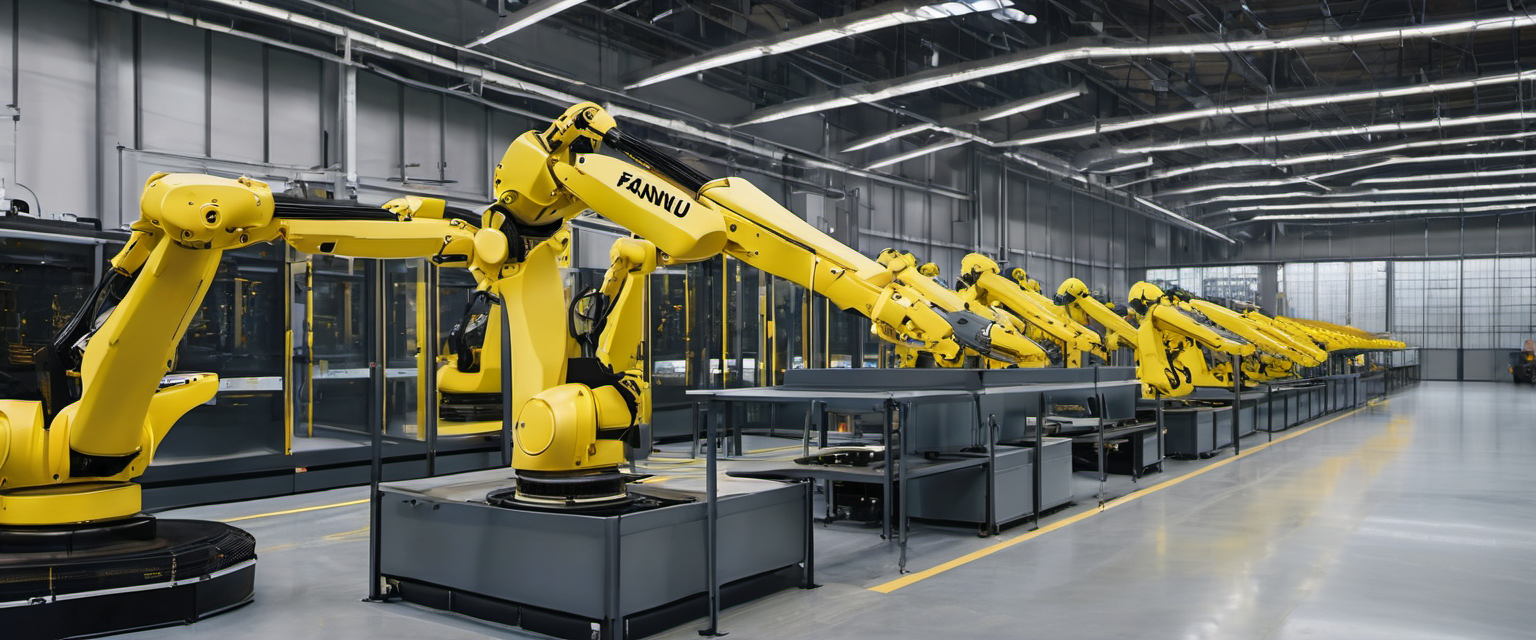
Fanuc Corp. — the world’s largest maker of industrial robot arms — announced on May 14 a partnership with Alphabet spanning Google Cloud’s Gemini Enterprise generative-AI suite and Intrinsic, Alphabet’s industrial-robotics software unit. The integration target is Fanuc’s ~1.1 million installed industrial robots worldwide. Tokyo-listed Fanuc shares rallied as much as 15.6% to an all-time high of ¥8,880 on the news, per Investing.com’s tick-by-tick coverage. It was the single biggest one-day Fanuc move in over a decade.
The headline numbers are not the story. The thesis underneath them is.
The brownfield bet, named
For 18 months the robotics capital story has been greenfield humanoid platforms — Figure, 1X, Apptronik, Mind Robotics — raising billion-dollar rounds against a pitch that goes roughly: “general-purpose bipedal labor will be cheaper than human labor by 2028.” Every funding round has reinforced that narrative, including the Mind Robotics $400M Series B at $3.4B from May 13.
The Fanuc-Google deal is the opposing thesis, named and capitalized for the first time in 2026. It says: the 1.1 million industrial robot arms already bolted to factory floors are the cheapest path to industrial AI — and the work is retrofit and orchestration, not new bodies. The integration scope, per The Next Web’s read on the announcement and Fast Company’s coverage, splits cleanly:
- Gemini Enterprise: natural-language tasking. Operators describe what a cell should do, the model produces the program. The training data is decades of Fanuc’s own task corpus.
- Intrinsic Flowstate: multi-robot orchestration. The dispatch and coordination layer that Intrinsic has been building since 2021 inside Alphabet’s X moonshot, now landing on Fanuc as its first major commercial chassis.
The two pieces together close the gap between “we have 1.1M arms and they each do one rigid task” and “we have a fleet that re-tasks itself in language.” The deal is not a humanoid hedge. It is the explicit alternative.
The +15.6% single-session move is the part the press release buries
Fanuc trades at structurally lower multiples than US robotics names. The stock has historically been a cyclical industrial proxy: it tracks China factory capex, German auto orders, and US capital-equipment cycles. The +15.6% session on May 14 was not a cyclical move. It was a multiple-expansion event — investors deciding that Fanuc is no longer just a robot-arm OEM but a distribution channel for frontier AI at the factory edge.
The math is straightforward. If Gemini Enterprise + Flowstate adds even ¥50,000 in annualized software revenue per installed robot — a fraction of what enterprise AI workloads charge in other categories — Fanuc gets ¥55 billion (~$370M) in incremental high-margin recurring revenue with effectively zero new capex. Apply software multiples to that line, and the +15.6% session looks conservative, not exuberant.
Why this is bad news for greenfield humanoid valuations
Three humanoid companies — Figure, 1X, Apptronik — have raised in the last 12 months at valuations that imply they will absorb the bulk of factory labor demand in the latter half of the decade. The Fanuc-Google deal is the first capital-markets-priced refutation of that thesis.
| Path to factory AI | Capex per deployed robot | Years to first revenue | Installed base today |
|---|---|---|---|
| Greenfield humanoid (Figure 03, 1X NEO, Atlas) | $30K–$60K hardware + $40K+ annualized service | 2–4 years per customer | <2,000 commercial units globally |
| Brownfield retrofit (Fanuc + Gemini Enterprise + Flowstate) | $0 hardware (already deployed) + software seat | <12 months on existing controllers | ~1,100,000 Fanuc units + ~1.45M from ABB/KUKA/Yaskawa if they follow |
The brownfield path doesn’t have to win — it just has to be plausible enough to compress the humanoid premium. Wednesday’s Tokyo move says it is.
The New Money’s read on the deal frames it as Fanuc preempting what would have otherwise been a category-wide threat — the risk that humanoids and AI-native upstarts marginalize 6-axis arms over a decade. Fanuc, rather than competing on humanoid hardware, has aligned with the AI layer that any future automation stack would need to interface with anyway.
What Intrinsic is now, after seven years
Intrinsic was spun out of Google X in 2021 by Wendy Tan White, with Flowstate as its visual-programming environment for industrial robotics. For its first four years, the product was good but the chassis was missing — Intrinsic was building software that needed to land on someone’s hardware base, and the major OEMs (Fanuc, ABB, KUKA, Yaskawa) all had their own proprietary stacks.
May 14 changes that. Intrinsic is now shipping on the largest installed industrial-robot base in the world, end-to-end. The Alphabet side of the deal is the more interesting one for the medium term: Intrinsic was Google’s bet on being the AWS of physical AI, and that bet was theoretical until Fanuc gave it a billion-dollar deployment runway.
Fast Company’s coverage of the deal hints that the Intrinsic Flowstate integration will roll out first on the new Fanuc CRX cobot series, then back-port to the legacy R-30iB Plus and R-30iB Mini controllers that dominate the installed base. The back-port is the line item that turns this from a partnership into a category event: it means existing 5–15-year-old Fanuc arms become eligible for AI-tasked workflows, not just new sales.
What this implies for the May 2026 robotics map
There are now three named theses in robotics capital, and Fanuc-Google clarifies the third:
| Thesis | Lead examples | Capital path |
|---|---|---|
| General-purpose humanoid | Figure ($1B+), 1X (~$1B), Apptronik ($520M), Boston Dynamics/Hyundai Atlas | Greenfield, equity-funded, multi-year horizon |
| Factory-floor industrial AI (purpose-built bodies) | Mind Robotics ($1B+ at $3.4B), Covariant, Symbotic, Humanoid AI + Schaeffler | Captive customer wedge, equity-funded, 2–3 year horizon |
| Brownfield retrofit (existing arms + AI layer) | Fanuc + Google (announced May 14), and the open question of whether ABB, KUKA, Yaskawa follow | Software ARR on installed base, equity multiple expansion, sub-12-month horizon |
The Tokyo session priced the third thesis at +15.6% in a day. If ABB (Microsoft + Azure OpenAI is the obvious counterparty), KUKA (a Chinese-owned firm that could plausibly pair with Baidu’s ERNIE or a domestic LLM), or Yaskawa (Mitsubishi or NTT) follow with comparable partnerships within Q3, the brownfield thesis stops being optional and becomes the dominant near-term capital flow in industrial robotics.
What to watch
- ABB’s response. ABB is Fanuc’s closest peer with ~600K installed units. The ABB-Microsoft relationship is already deep at the Azure layer. A comparable ABB partnership announcement is the highest-probability follow-on in Q2.
- KUKA’s geopolitical layer. KUKA is Chinese-owned (Midea, since 2016). It cannot do a deep Gemini or GPT integration without political risk. The most plausible KUKA path is a domestic LLM partnership — DeepSeek, ERNIE, or Qwen — which would split the brownfield thesis along a US/China axis from day one.
- The Fanuc CRX rollout timeline. Fanuc has not publicly committed to a quarter for Gemini Enterprise availability on the CRX series. The press release was a partnership announcement, not a product release. The first GA quarter is the operational read on whether this is real engineering or an aspirational MOU.
- Capex effects on greenfield humanoid raises. A Figure or 1X round that closes after Q3 will price into a world where the brownfield retrofit thesis exists and is capitalized. The mark may not come down in absolute terms — capital is still plentiful — but the diligence questions get harder. “Why not retrofit?” is now a viable counter-thesis to “Why not build a new body?”
The May 14 announcement was not a humanoid story and the Tokyo session priced it accordingly. 1.1 million arms, +15.6% in one day, and a 70-year-old industrial automation OEM suddenly trading as a frontier-AI distribution channel. That is the part the next humanoid Series C investor deck will have to address.
Sources
- Bloomberg — Fanuc Shares Jump to Record After Announcing Google AI Robotics Partnership
- Investing.com — Japan’s Fanuc shares hit record high on Google physical AI partnership
- The Next Web — Fanuc partners with Google to bring Gemini AI and Intrinsic platform to 1.1 million industrial robots
- The New Money — FANUC Cuts Deal With Google For Leading Edge Robotics Software