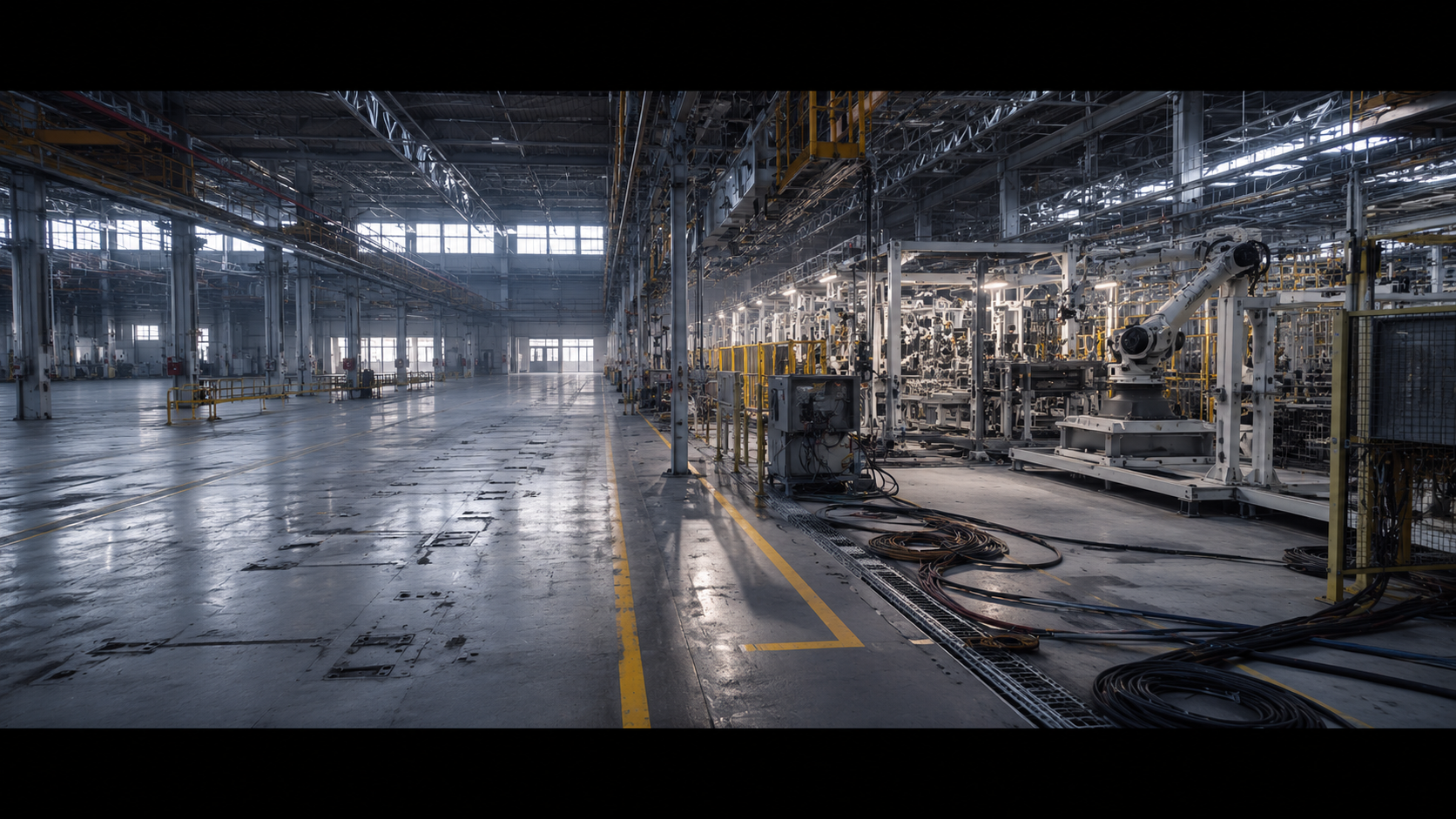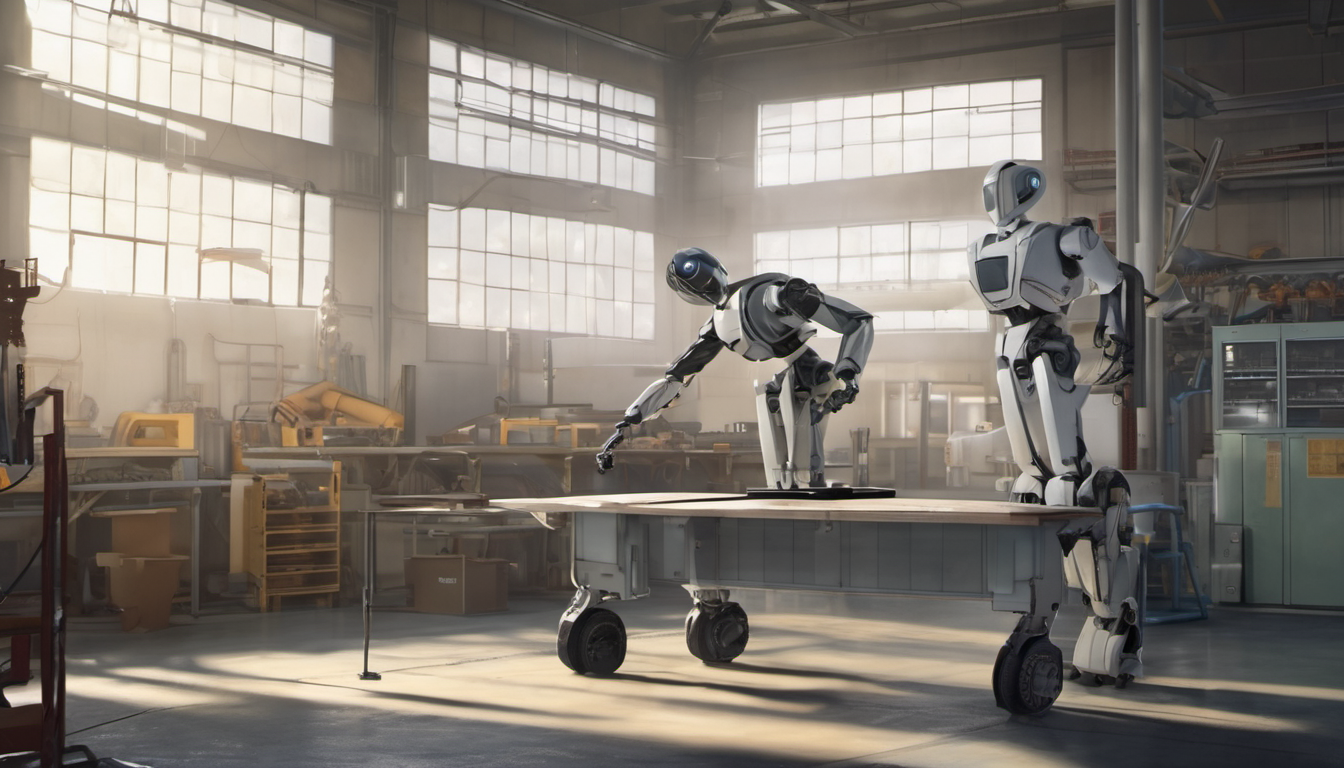

Rivian CEO RJ Scaringe’s robotics spinout Mind Robotics announced on May 13 that it had closed a $400 million Series B led by Kleiner Perkins, lifting its valuation to $3.4 billion post-money and bringing total disclosed funding above $1 billion. Participating investors include the corporate venture arms of Volkswagen Group and Salesforce, with Rivian itself remaining a shareholder. The Series A — closed in March 2026 — was a $500M round at a $2B valuation. Add the $115M seed and Mind has gone seed → $2B → $3.4B in roughly five months with a single dedicated training site: Rivian’s Normal, Illinois plant.
The number is not the story. The deployment is.
Project Synapse, externalized
Mind Robotics was originally an internal Rivian effort called Project Synapse until it was spun out as a standalone company in November 2025. The model is the same captive-customer-turned-platform pattern that built Amazon Robotics (Kiva), Cruise (GM), and arguably Waymo (Google) — a vertically integrated buyer underwrites the first years of deployment, then the technology becomes a sellable platform once it works in the demanding internal use case.
What makes the Mind case unusual is the size of the wedge:
- Project Synapse internal: roughly 12 months of pre-spinout development inside Rivian.
- Seed → Series A → Series B: ~5 months from spinout to $3.4B valuation.
- Single training site: Rivian’s Normal, IL plant, where the R1T, R1S, and the upcoming R2 mass-market SUV are built.
Per Crain’s Chicago Business, hundreds of Mind units are already deployed on the Normal floor. This is not “the next Figure.” Figure is building a humanoid platform for general manipulation. Mind is building factory-floor industrial AI robots — closer in shape to Covariant or Symbotic than to a bipedal humanoid — that target the messy long tail of assembly-line tasks where traditional industrial automation fails: tasks requiring precision, judgment, and flexibility on parts whose geometry varies slightly run-to-run.
The pitch in the Mind Robotics announcement is a single integrated platform spanning the AI models, the robot hardware itself, and the fleet-management software needed to run hundreds of units inside a working plant. The implicit competitive comparison is to a stack like Symbotic+RaaS — not to a humanoid like 1X NEO or Figure 03.
The Rivian factory is the deployment that matters
The Normal, IL plant is now functioning as Mind Robotics’ physical product-market-fit lab. The technology that started as a Rivian cost-savings line item is now a $3.4B standalone with VW Group and Salesforce as outside backers — and Rivian is both the operating customer and a holder of the upside via its remaining equity stake.
The labor implication is the part nobody at Mind will say on the record. Rivian’s Normal plant employs roughly 9,000 workers today. The Mind Robotics announcement explicitly says the platform targets manufacturing “labor shortages.”
「Labor shortage」 in 2026 industrial vocabulary now reliably means one of two things: (a) the company cannot hire at the wage it wants to pay, or (b) the company would prefer not to hire at any wage if there is a robot that can do the task. Both readings produce the same purchase order. Mind Robotics is the purchase order.
Why Kleiner, Volkswagen, and Salesforce
The investor lineup is the second-derivative tell.
Kleiner Perkins is a generalist top-tier VC with a strong infrastructure-AI thesis under partner Bucky Moore. The lead is unsurprising but the price is stretched: a Series B at $3.4B is a high mark on a company shipping its first commercial deployments inside one customer. KP is paying the early-mover premium that the broader industrial-AI category will not give them in 12 months.
Volkswagen Group’s venture arm participating is the signal that Mind is being scoped as a buy-side option for VW’s own North American assembly plants — particularly the Chattanooga ID.4 line and the upcoming Scout Motors plant in South Carolina, both of which VW has publicly identified as cost-pressure sites. An external robotics platform with Rivian factory data is a cheaper bet than building a robotics group in-house.
Salesforce Ventures is the most-confusing entry in the cap table. Salesforce does not build factories. The most defensible read is strategic: a robotics control plane whose telemetry feeds back into the enterprise data layer — Salesforce Data Cloud + Agentforce — is the kind of edge integration Salesforce keeps trying to acquire. The strategic value here is for Salesforce, not for Mind. The cap table tells you which way the future partnership flows.
The notable absence from the Series B: Andreessen Horowitz, which led Series A. Either Mind chose to bring in strategics and reduce a16z’s pro-rata, or a16z chose not to defend the mark at $3.4B. Both readings have follow-on implications for what the round looks like in Q4.
What this means for the May 2026 robotics map
There are now three distinct robotics theses absorbing 9-figure rounds in mid-2026, and they target three different labor problems.
| Thesis | Lead examples | Target labor problem | 2026 funding heat |
|---|---|---|---|
| General-purpose humanoid | Figure ($1B+), 1X (~$1B), Apptronik ($520M) | Flexible bipedal labor across industries | High |
| Factory-floor industrial AI | Mind Robotics ($1B+), Covariant (pre-Amazon), Symbotic (public) | Long-tail assembly + warehouse work | Now high |
| Wheeled / task-specific | Humanoid AI with Schaeffler, AEON wheeled humanoid, Agility Digit, AGIBOT | Specific repetitive industrial tasks | Mid |
Mind is the cleanest industrial-AI funding outcome in May 2026. The fact that it is the size of a humanoid Series B with none of the platform risk of a bipedal robot is the part that explains the $3.4B mark. Investors are paying a humanoid-grade valuation for what is functionally a Symbotic-grade product, on the bet that the Rivian factory data moats it.
This is the inversion of the Figure 03 28K-package-24h livestream from May 14: Figure proved that a humanoid platform can run unsupervised for a day; Mind proved that an industrial-AI platform can raise unsupervised at a single-customer plant for five months.
What to watch
- The first non-Rivian customer announcement. This is the test of whether Mind is a platform or a captive subsidiary. Plausible candidates per the cap-table read: VW Chattanooga, Scout Motors, a defense-adjacent metals fabricator, or a Stellantis JV plant.
- R2 launch and Mind fleet size on day one. Rivian’s R2 mass-market SUV is on track for a 2026 production start at Normal. The Mind robot fleet size deployed on the R2 line at launch is the operational read — and the one that the VW board will be watching.
- The UAW response. Rivian Normal is the canonical test bed for an unrecognized organizing campaign at a non-Big-Three EV plant. Mind Robotics deploying inside the same campus changes the bargaining math. The union’s public posture on robotics-driven labor displacement at non-union plants is the next move.
- The next round. A $3.4B Series B in May with hundreds of robots deployed inside one customer means the next mark is plausibly $5–7B by Q4 if a second OEM signs. The story is now priced as a winner; the next round will tell us whether the platform thesis holds outside Normal. If the next round doesn’t materialize at a step-up by Q4, the $3.4B mark was the top.
The May-2026 robotics map now reads cleanly: humanoids absorb capital on the long-bet bipedal platform; factory-floor industrial AI absorbs capital on the near-bet brownfield deployment. Mind Robotics is the second-quadrant outcome and the largest one this month. $1B+ in funding, $3.4B valuation, one customer, hundreds of deployed units, and a Rivian assembly line that just doubled as a Series B pitch deck.