
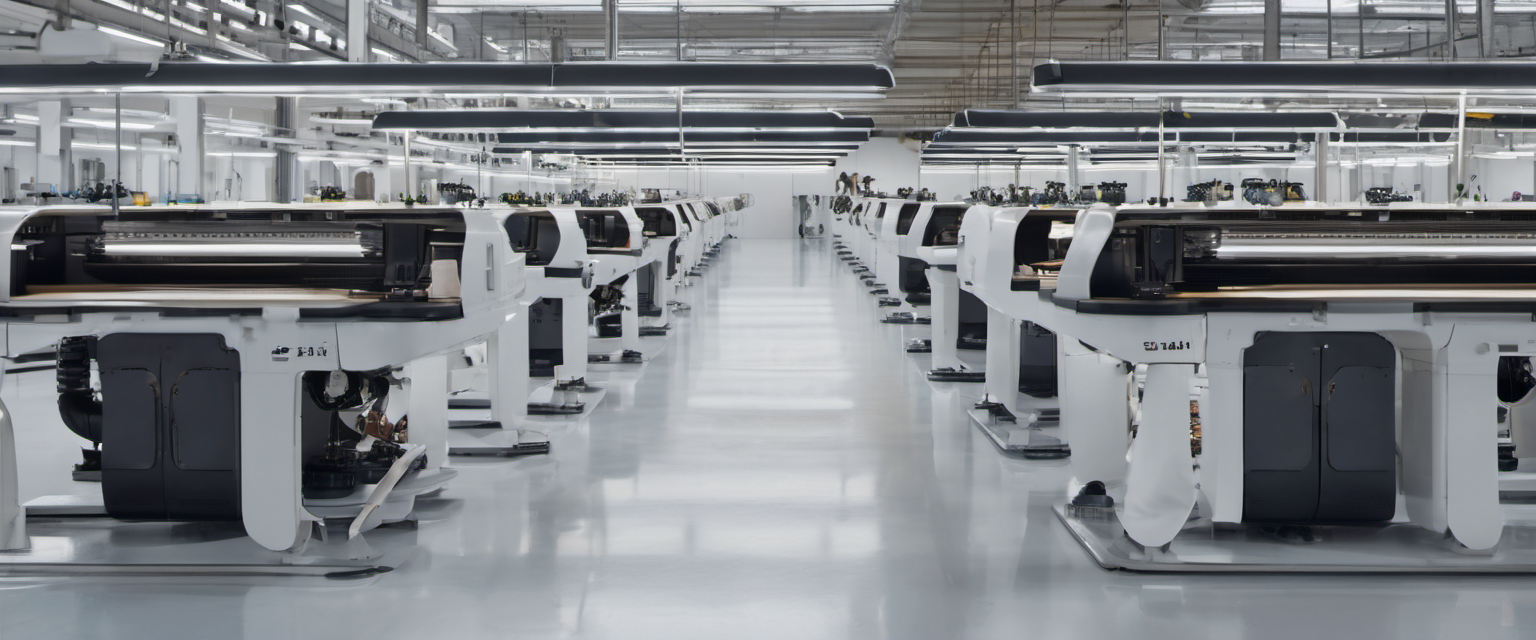
On May 13, Zhejiang Humanoid Robot Innovation Center Co., Ltd. announced a strategic partnership and binding 2,000-unit order from Jack Technology — the Taizhou-headquartered company that makes more industrial sewing machines than anyone else on the planet — for the NAVIAI humanoid robot, customised for garment-manufacturing workflows. Per the Gasgoo announcement, this is the first mass-scale humanoid robot deployment in the global apparel industry.
For a sector that has resisted full automation for two centuries — the sewing machine, the conveyor line, the vision-system pick-and-place have each entered apparel and each been only partially digested — a 2,000-unit signed order is the kind of structural news that takes ~24 hours to sink in. The reason apparel resisted is not nostalgia. It is that fabric is soft, draping, non-rigid, and shape-changing. The industrial robot stack assumes none of those properties.
What the spec sheet actually says
Per the Gasgoo brief, the Aibase profile of NAVIAI 2.0, and the Humanoid.guide entry for Navigator 2:
| Spec | Value |
|---|---|
| Form factor | Bipedal humanoid (Navigator 2 / NAVIAI) |
| Height | 1.65 m |
| Weight | 60 kg |
| Degrees of freedom | 41 |
| On-board compute | 275 TOPS |
| Cut-piece alignment | ±2 mm |
| Sewing / cutting motion precision | 0.3–0.5 mm |
| Single-step operation | under 10 seconds |
| Multi-layer stacking accuracy | <2 mm across multiple plies |
| Material range validated | polo (light woven) → denim (heavy woven) |
The numbers that matter are not the height and weight. They are the ±2 mm cut-piece alignment and 0.3–0.5 mm motion precision. Garment manufacturing is the assembly task where the part being held does not hold its own shape — and the failure mode for every previous-generation manipulator is the part is in a different geometry after you pick it up than it was before. The 「polo through denim」 material-range claim is the second number that matters: light woven and heavy woven sit at opposite ends of the fabric-handling difficulty spectrum, and the NAVIAI’s reported ability to handle both means it has solved at least the lower-bound version of the soft-material grasp problem.
Why Jack Technology of all customers
Jack Technology is the world’s largest industrial sewing machine maker — its installed base sits in apparel factories from Bangladesh to Bengaluru to the Pearl River Delta to North Carolina to Honduras. The company began publicly signalling its humanoid-robot pivot on April 30, and its own Futubull-tracked roadmap sets H2 2026 as the launch quarter for its first humanoid-augmented production line.
The irony is structural. Jack Technology built the company that displaced the tailor. The industrial sewing machine, perfected through six generations of Jack hardware since the 1950s, is what replaced the hand-stitched garment economy that employed tens of millions of people across South China, South Asia, and Central America. Jack made that displacement possible. Now Jack is buying 2,000 humanoid robots to replace the operators of its own sewing machines.
The customer most embedded in apparel’s last automation wave is the one most aggressively financing the next.
Why the ±2 mm number is the news
In garment manufacturing, the engineering language for 「the robot can do the job」 is alignment tolerance and motion precision. The benchmark numbers, from Zhejiang Humanoid’s POC validation:
- ±2 mm on cut-piece alignment — the tolerance for a collar to mate with a torso panel without visible offset.
- 0.3–0.5 mm on motion precision — the tolerance required for stitch-line consistency on visible seams.
- <2 mm on multi-layer fabric stacking — the geometry required for a 4-layer denim assembly to sew straight.
- Under 10 s per single-step operation — i.e. cycle time per fabric pick-fold-align-place.
The published numbers put NAVIAI inside the working tolerance for outerwear and casualwear assembly, where the alignment requirements are looser than haute couture but tighter than upholstery. That is the volume layer of global apparel: t-shirts, polos, jeans, fleece, basic outerwear. The 2,000-unit order is sized to that layer specifically — it is not the entire apparel sector; it is the segment Zhejiang Humanoid’s R&D has actually validated for.
R&D timeline: 18 months from start to mass order
Per Sango Automation’s profile of Zhejiang Humanoid:
- September 2024: Specialised R&D begins on NAVIAI for template-machine garment processes.
- July 2025: NAVIAI passes POC validation on cut-piece template operations.
- May 13, 2026: 2,000-unit signed order from Jack Technology.
Eighteen months from start of dedicated R&D to mass order is the timeline that should be the actual headline. It is consistent with the Chinese humanoid sector’s aggregate pace of moving from prototype to volume — TrendForce projects Chinese humanoid robot output to grow 94% in 2026, with Unitree and AGIBOT alone accounting for ~80% of total shipments. Zhejiang Humanoid is not in that top two; it is a Ningbo-municipal-government + Zhejiang University joint venture established December 21, 2023, two and a half years old. Its single largest contract to date doubles its order book in a calendar day.
What this signals for the global apparel labour market
Three structural reads, in increasing order of how much the apparel industry will hate them.
One. The 2,000-unit order is a deployment, not a pilot. Pilots are 5–20 robots; deployments are 200+. A 2,000-unit purchase commits Jack Technology to integrating the NAVIAI into multiple customer production lines — its customers being apparel manufacturers, not Jack itself — and the contract structure implies a Robot-as-a-Service or quasi-RaaS model where Jack is the integrator and the apparel factories are the end users. That distribution model is exactly what the Schaeffler x Humanoid contract on the same day also used: the supplier becomes the deployment vehicle. The May-13 humanoid news cycle produced two binding 2,000-unit orders structured the same way, in two industries (industrial bearings, apparel).
Two. Apparel is the largest employer of women in low-income economies. The ILO estimates 60–80 million people are directly employed in garment manufacturing globally — overwhelmingly women in Bangladesh, Vietnam, Cambodia, Indonesia, India, China, Honduras, Guatemala. A working ±2 mm humanoid for assembly does not replace 60 million workers in 2026 — but it is the first time the spec sheet exists. The number that should be tracked from here is not 「how many sewing jobs lost」 — it is 「what is the per-unit price of a NAVIAI in 2027 and how does it compare to one month of Vietnamese minimum wage」, because that is the curve that decides the timeline. Zhejiang Humanoid has not disclosed unit pricing for the Jack order.
Three. Apparel was supposed to be the last hard sector. Footwear, eyewear, and luggage have all moved further along the automation curve than apparel because the parts are more rigid. If apparel falls — even partially, even just the volume layer — the conventional wisdom that the bottom of the labour-cost curve is structurally protected from humanoid automation no longer holds. The companies on the other end of that supply chain — Inditex, H&M, Uniqlo, Shein — have not commented on the Jack order. They will not be able to ignore the H2-2026 deployment.
What to watch
- Jack Technology’s H2 2026 launch announcement. Futubull’s tracking puts the production-line launch in the second half of this year. The first reference customer will be a named apparel brand — that name is the next material data point.
- NAVIAI unit pricing. Zhejiang Humanoid has not disclosed per-unit pricing for the 2,000-robot order. The benchmark to beat is the 1X NEO at $20,000 and the Unitree H1 at ~$90,000, and to break the apparel-labour cost curve the price needs to be inside ~$15,000.
- The bipedal vs. wheeled split. Zhejiang Humanoid went bipedal where the Schaeffler x Humanoid deal went wheeled. Bipedal works in apparel because the workstations are designed for human reach; wheeled works in industrial assembly because the conveyors are floor-aligned. The May-13 doublet — bipedal for garments, wheeled for bearings — is the form-factor split for the next 24 months of humanoid deployment by industry.
- The next Chinese garment-manufacturing entrant. Zhejiang Humanoid is a regional Ningbo-Hangzhou-Zhejiang University vehicle. The Shanghai (AGIBOT) and Hangzhou (Unitree) competitors do not yet have a published apparel programme. They will by the end of 2026.
The morning-after read: the 200-year-old industry that automation had only partially digested — every previous wave (the sewing machine, the conveyor line, the vision pick-and-place) had moved the floor but never the assembly station — just had its assembly station entered by a bipedal humanoid customised for fabric, by the company that sells the sewing machines, in an 18-month dev cycle, with a binding 2,000-unit order. The number to watch is not 2,000. It is whatever Jack Technology orders in 2027.