
Unitree G1
Made by Unitree Robotics
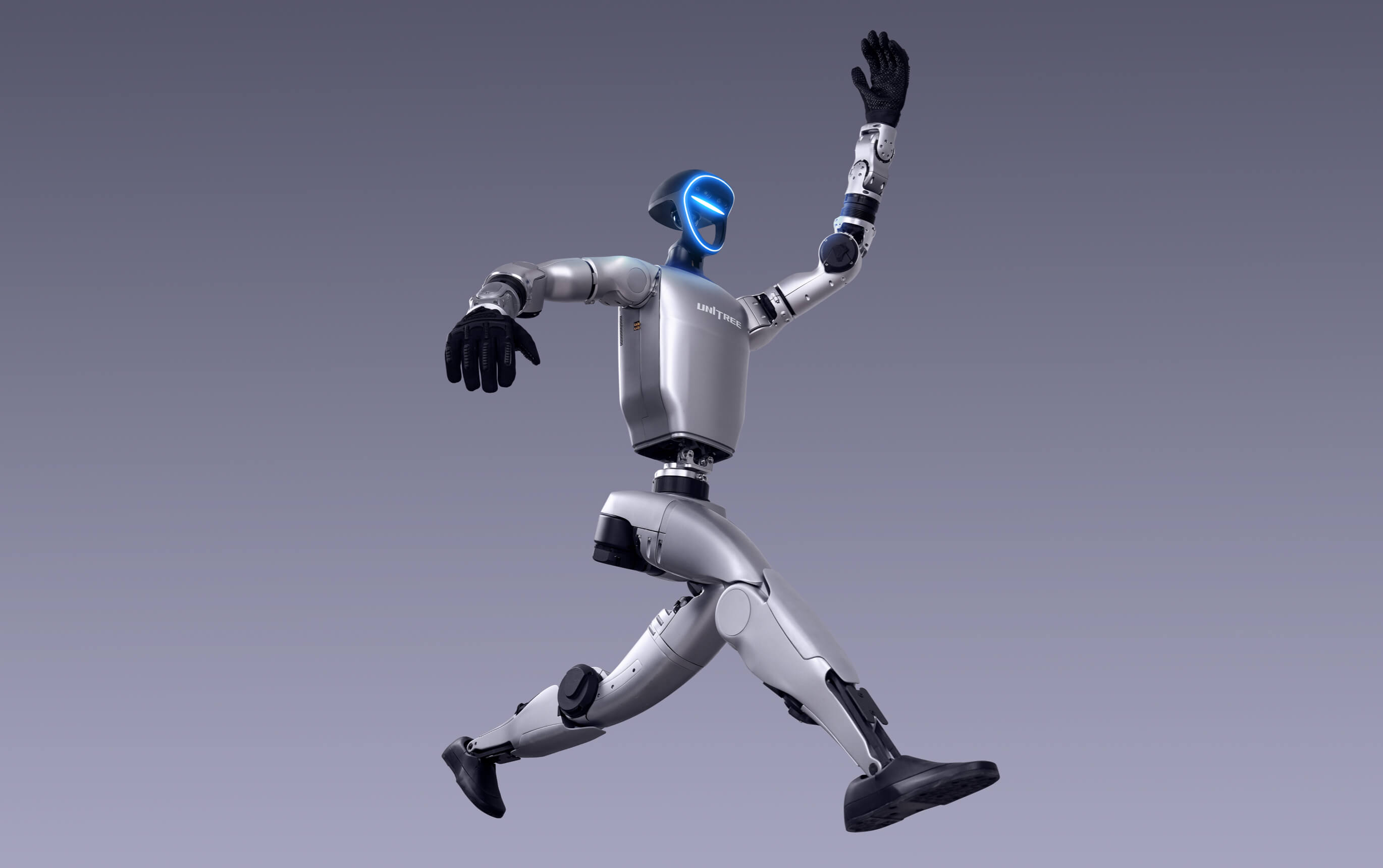
Photo: Unitree Robotics
- sensors
- 3D LiDAR + Depth Camera, 4-mic array
- height cm
- 132
- weight kg
- 35
- dof edu max
- 43
- dof standard
- 23
- max speed mps
- 2
- arm payload kg
- 2
- compute standard
- 8-core CPU
- battery runtime min
- 120
- compute edu optional
- NVIDIA Jetson Orin
Who's exposed
Jobs in the threat radius
- warehouse picker
- airport baggage handler
- light assembly line worker
- inventory clerk
Deployment status
Shipping commercially since 2024. Deployed at Tokyo Haneda Airport with Japan Airlines and GMO Internet Group for baggage and cargo handling — the first commercial humanoid airport deployment we are aware of. Over 5,500 G1 units shipped in 2025 per Unitree; production targeted at 10,000–20,000 units in 2026.
When this hits the labor market
1-3 years for greenfield warehouse picking and light assembly, where the environment can be designed around the robot. 3-5 years for retrofit deployments in existing facilities. Generalized household work is further out and is not where the labor displacement happens at scale anyway.
Is this robot coming for your job?
Press releases speak in averages — LostJobs talks about your role. Find out which parts of your job hold up and which don't. Free.
Talk to LostJobs about my future
The cheapest humanoid that actually ships
The Unitree G1 is the cheapest production bipedal humanoid you can buy in 2026. The Basic configuration starts at $16,000 on Unitree’s shop site; G1 Standard sits at $21,600, the EDU lineup begins at $43,900, and the top-spec Ultimate D — Jetson-class compute, three-fingered dexterous hands, full SDK access, open-source manipulation model — caps at $73,900. Sixteen configurations span the line. For context, most industrial humanoid platforms from Western manufacturers price in six figures.
That price point matters more than any single spec. The G1 is what gets put in front of the largest number of engineers and integrators. The robot that becomes the default isn’t the most capable one — it’s the one that’s cheap enough to break.
What it actually does today
Standing 1.32m, 35kg, with 23 degrees of freedom and roughly two hours of battery, the G1 walks reliably on flat and slightly uneven ground at around 2 meters per second. The standard arm carries about 2kg per side. The EDU version adds force-controlled dexterous hands. Both ship with 3D LiDAR, depth cameras, and access to Unitree’s SDK.
Real-world deployments are not academic. Unitree’s own numbers put 5,500 G1 units in the field in 2025, with a target of 10,000–20,000 for 2026. Tokyo Haneda Airport began a commercial pilot in partnership with Japan Airlines and GMO Internet Group, using G1 units for baggage and cargo handling — to our knowledge the first commercial humanoid airport deployment. In March 2026, Unitree open-sourced UnifoLM-VLA-0, a vision-language-action model that lets the G1 act on natural-language instructions for household tasks.
That last point is the one that matters. The hardware was the hard part five years ago; now it isn’t. The bottleneck has shifted to the perception-action models, and open-sourcing the model accelerates the rate at which third-party integrators close the capability gap on specific use cases.
Why we care for LostJobs
The first job categories to feel pressure from G1-class hardware are the ones where the environment can be shaped around the robot rather than the other way around: greenfield warehouses, baggage handling along a known corridor, fixed-route light assembly. Those are 1–3 years away for early adopters. Retrofitting existing facilities — where the layout, lighting, and aisle widths were designed for humans — is 3–5 years. Generalized household tasks are further out, and they’re not where the labor displacement happens at scale anyway.
If your job description includes the words warehouse, fulfillment, airport ground handling, or light assembly, the G1 is the early warning, not the alarm. The economics start working when the integrator cost (training, software, mounting, maintenance) drops below the cost of the human labor it replaces. At $16K Basic / $21.6K Standard hardware, that math closes faster than it did at $200K — even with the slight 2026 price normalization upward from the earlier sub-$15K headline.