
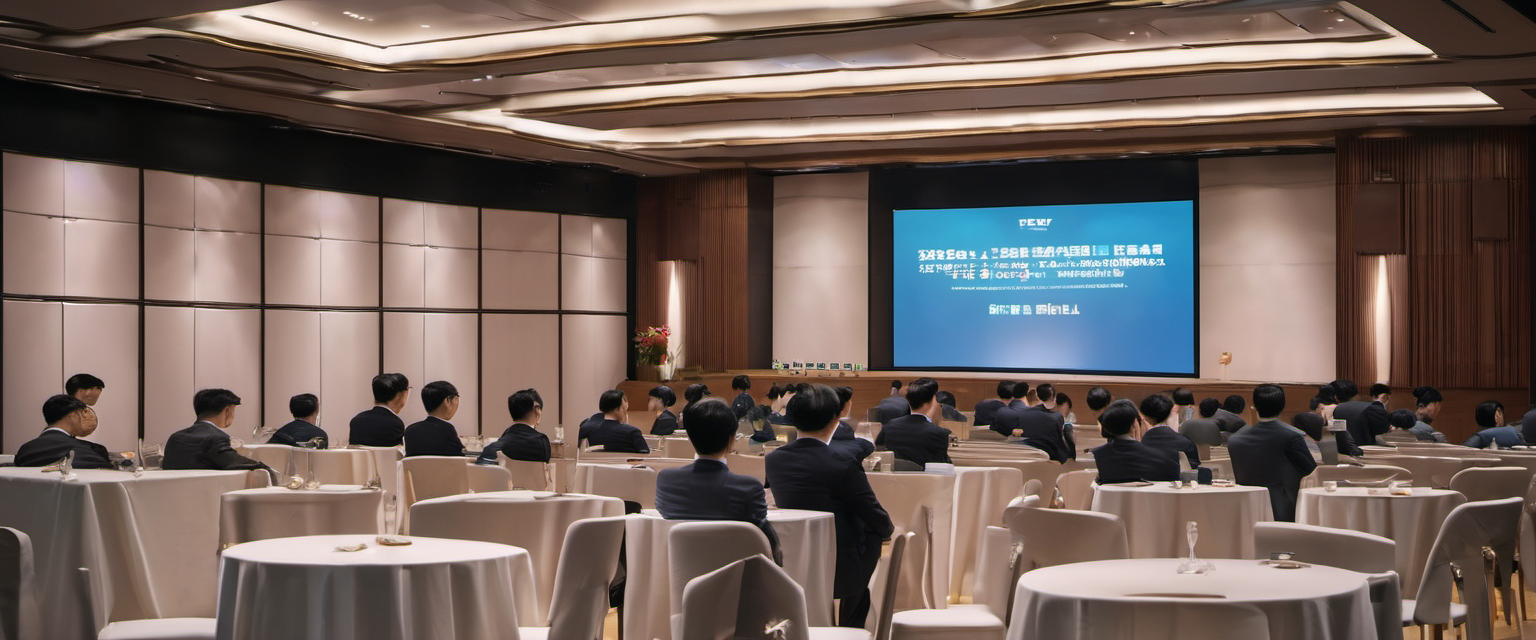
The line that Michael Perry built the keynote around is, in the literal sense, an accounting argument. “Humanoids are not simply ‘better robots,’ but a different category of Capital that handles work fixed automation could never solve,” he said. “The economics change not because labor becomes cheaper, but because capital — robots — is amortized across more tasks.”
That line is the framing Persona AI is taking on the road to its commercial customers — Korean shipyards, US steel mills, offshore energy. On May 27, 2026, at the Shilla Hotel in Jung-gu, Seoul, Perry — Persona AI’s Chief Commercial Strategy Officer, formerly DJI North America MD (2014–2018), then VP of Business Development at Boston Dynamics, then VP of Marketing at Dexterity — delivered the keynote at Seoul Economic Daily’s 66th-anniversary Seoul Forum 2026, themed “New Core, New Industry.”
The headline numbers Perry put in front of a room of Korean heavy industry CEOs: the average age of production workers at Ulsan shipyards is 48.3 years. US manufacturing alone is projected to have 2.1 million unfilled jobs by 2030. The annual revenue loss to global manufacturing from labor shortage is approximately $1 trillion. He framed all three under one term: the “silver tsunami.”
The four prerequisites
The argument Perry made for why humanoids matter — and why fixed automation does not solve the silver-tsunami problem — comes down to the four conditions that conventional industrial robots require to be deployable: mass production, standardized inputs, repetitive outputs, and stable processes. Those four conditions are, in his phrasing, the reason that “unstructured and hazardous tasks at heavy industry sites — such as hull welding at shipyards or offshore platform inspections — have remained blind spots of automation, or ‘value gaps.’”
This is the part of the pitch that is doing the most work, and it is the part the industry has not yet had to settle. The KraneShares-style 2026 humanoid narrative — see Figure’s 11-month Spartanburg deployment (1,250+ hours, 90,000+ parts moved, ~30,000 BMW X3 vehicles), Agility’s 18-month run at Amazon Sumner (98% task success on tote handling), the Schaeffler 1,000–2,000 robot binding deal with Humanoid UK, the JAL/Unitree two-year Haneda trial — is overwhelmingly inside Perry’s first three conditions. Tote handling, sheet-metal loading, baggage transfer, even Hyundai’s Atlas L-sit handstand demo on May 6 — these are stable processes with standardized inputs and repetitive outputs, the kind of work that, in principle, fixed automation could already do at a higher cycle rate. The reason humanoid robots are showing up on those floors anyway is mostly that the cost of retooling a line for one new task has crossed under the cost of a Robot-as-a-Service contract.
Hull welding at Ulsan is a different argument. So is offshore platform inspection. So is the kind of high-mix, low-volume, hazardous-environment task that Persona AI says it is targeting. That is the “value gap” Perry is pricing. Whether Persona AI — or any of the current humanoid generation — can actually close that gap inside a 24-month deployment cycle is the unsettled commercial question.
What “amortized across more tasks” really claims
The Jevons-paradox version of the AI-labor argument that Altman, Amodei, and Solomon have been running in the white-collar context — productivity goes up, total demand goes up, employment stays roughly flat — does not transplant cleanly onto a shipyard. The white-collar version assumes the cost of writing one more memo, one more code review, one more compliance report, is the binding constraint, and that lowering it expands the market for memos, code reviews, and compliance reports.
Perry’s version on a heavy-industry floor is structurally different. The binding constraint is not the cost of one more weld. It is the number of welders willing to take the shift. When the binding constraint is a shrinking pool of human labor — and the average shipyard worker is 48.3 and there are 2.1 million unfilled US manufacturing jobs projected by 2030 — the elasticity argument inverts. Cheaper welding does not expand the market; the market is already starved for welding capacity at any price the shipyard can sustain. What humanoids buy you, if they work, is not “more welds per dollar” but “any welds at all on a hull whose welders are retiring next year.”
That is why the “capital, not labor” framing matters as a sales tool. It tells the Hyundai Heavy CFO that the line item on the budget is no longer the variable-cost row labeled “labor we cannot hire” but a depreciation row labeled “robot fleet we own or lease, with a 5-to-7-year amortization schedule.” The CFO can underwrite the second line. The first one was already an unbookable risk.
What is being underwritten today
The commercial reality, as of late May 2026, is that the binding humanoid deployments are still inside fixed-automation-adjacent tasks. The Figure-BMW deployment was largely material movement on a single station. The Agility-Amazon deployment is tote handling. The Schaeffler-Humanoid deployment, when it begins in December 2026, starts with “box handling” at the Herzogenaurach site. The Boston Dynamics/Hyundai 2026 commitment is fully booked. None of these are hull welds or offshore inspections.
Persona AI is selling against the next deployment generation — the one that has to work on a hull, in a paint booth, in a refinery, under PPE constraints that current humanoids do not yet uniformly satisfy. The under-priced risk in Perry’s pitch is the gap between the demo videos (which look like Hyundai’s L-sit) and the certifiable, OSHA-and-MSHA-and-Korean-Ministry-of-Employment-compliant welding workcell that a shipyard procurement officer can actually sign off on.
The under-priced opportunity, by the same token, is real. If the “capital, not labor” framing holds — if a humanoid platform truly amortizes across hull welding and offshore inspection and paint-booth survey and foundry sampling on a single embodiment — the unit economics for a shipyard or refinery are different from anything fixed automation can offer.
What to watch
- Korean shipyard pilots. Persona AI is positioning itself in a Korean industrial environment that includes HD Hyundai Heavy and Samsung Heavy. If a public pilot is announced at Ulsan or Geoje in the next two quarters, the May 27 keynote will read as the framing pre-amble. If not, the keynote was a category-creation exercise.
- The next four-prerequisite-breaker. Schaeffler-Humanoid’s December 2026 box-handling pilot is still inside the four conditions. The first humanoid deployment publicly framed against an unstructured task — hull welding, offshore inspection, refinery survey — is the one that tests Perry’s thesis. It will probably come from one of: Persona AI, Apptronik (energy), or 1X (consumer/service).
- The capex-vs-opex framing. “Robots are capital, not labor” is, for accounting, a meaningful claim. If the Robot-as-a-Service contracts that dominate today’s pilots — including Humanoid’s RaaS with Schaeffler — start being replaced by outright purchases on a 5-to-7-year amortization, the capex framing has won. If they stay RaaS, the OpEx framing is closer to what enterprise CFOs will actually pay for.
- The $1T number. Perry’s $1T global manufacturing labor-shortage number is the headline of this keynote. If it shows up in a McKinsey or BCG report by end-2026 with the same attribution path, the framing will have stuck. If not, it will be remembered as a Seoul Forum line.