
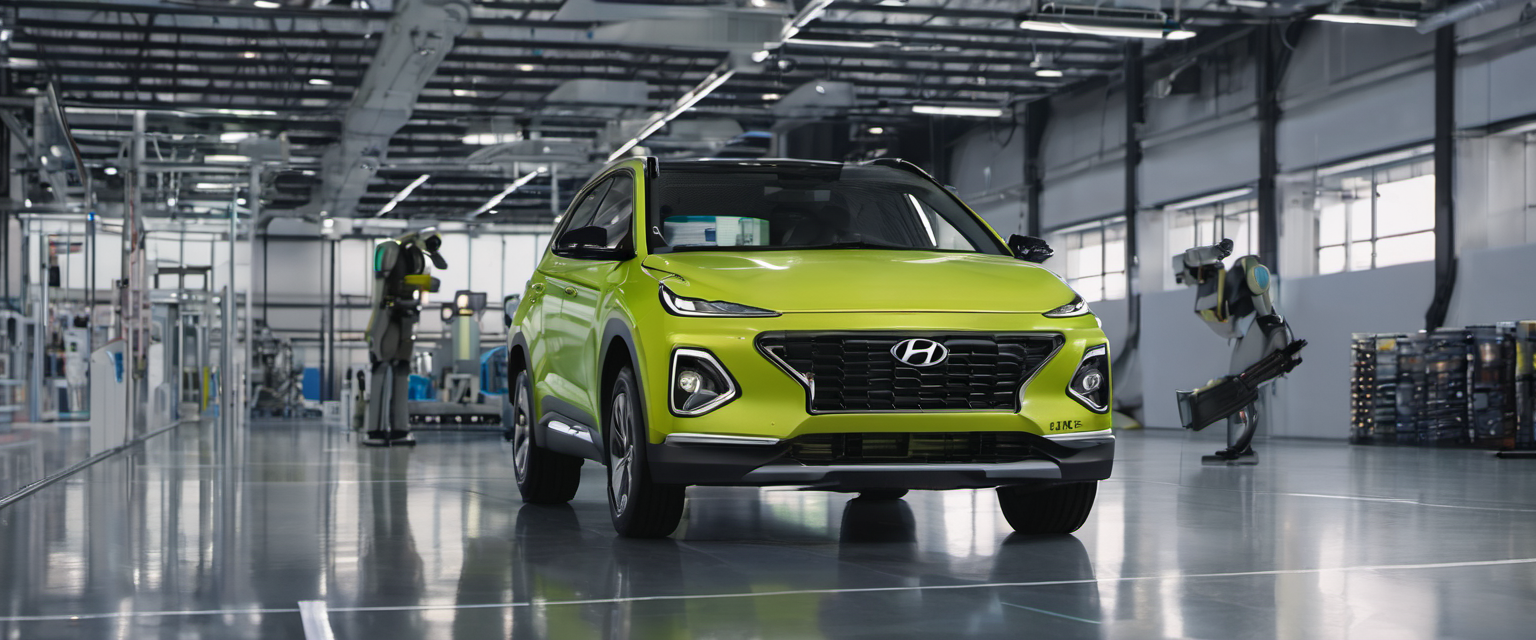
There is a moment in the lifecycle of every disruptive technology where the people selling it stop showing it doing the disruption and start showing it doing something charming. Self-driving cars stopped publishing intervention data and started releasing dog-trip videos. Generative AI stopped showing CFOs the headcount-reduction numbers and started shipping greeting cards. Atlas has now reached that stage.
On May 25, 2026, Hyundai Motor Group uploaded a short film to its official YouTube channel titled “School of Football — Can football teach a robot to move?”. The footage shows Boston Dynamics’ production Atlas standing in front of a wall monitor watching past World Cup match clips, walking to a marked practice area, attempting the gestures it has just observed, and connecting with a regulation FIFA ball. Korea’s Seoul Economic Daily covered it the same day. The video sets off a “miniseries” — additional spots will run as the tournament approaches.
The campaign these spots belong to is not new. On April 1, 2026 at the New York International Auto Show, Hyundai unveiled “Next Starts Now,” naming South Korea captain Son Heung-min as global brand ambassador for the FIFA World Cup 2026 and trailering two campaign films — one for Son, one for Atlas. The May 25 upload is the second one.
What the casting is
The casting is not a Boston Dynamics demo reel. Boston Dynamics has been publishing those for years. The casting is Hyundai Motor Group, the global FIFA sponsor, formally putting Atlas into a brand-ambassador role alongside the captain of its home-country national team — and committing to a video calendar that runs from now through the tournament. The robot is being promoted to corporate spokesmodel.
It is the same robot, manufactured by the same Hyundai-owned subsidiary in Waltham, Massachusetts, that Hyundai committed 25,000 units of to its own and Kia’s plants on May 19, with the first deployment penciled in for the Hyundai Motor Group Metaplant America in Bryan County, Georgia, in 2028. The annual production target is 30,000; internal absorption is 83% of that. The economics, as the Korean Metal Workers’ Union’s January 22 statement laid out, are: a single Atlas costs roughly 200 million won (around $145,000), runs three shifts, and pays itself off against the wages of about three line workers in under two years.
The union’s position, restated in a public statement and reaffirmed last week via Tech Times: “Keep in mind that not a single robot can enter the workplace without labor-management agreement.” Kia’s union made a parallel move on May 3, blocking robots and AI from its plants and tying any concession to a demand for 30% of operating profit as a bonus. The 2026 summer contract round is the escalation point.
So the marketing arc and the deployment arc are running at right angles. In one arc, Atlas is the face of the World Cup, learning to kick a ball alongside Son Heung-min. In the other arc, Atlas is the line item the union will spend the summer trying to keep off the assembly floor.
Why this is the move
Three reasons the corporate communications team is running the campaign in this order.
The brand needs the warmth. A humanoid robot designed to “handle really repetitive, really back-breaking labor” — Boston Dynamics CEO Robert Playter’s phrasing on 60 Minutes — does not generate warmth on its own. A humanoid robot watching a soccer match, mimicking a kick, and standing next to a Tottenham captain in a national-team kit does. The Atlas the public meets in 2026 needs to be the one in the soccer ad, not the one in the union’s spreadsheet.
The schedule needs the screen time. Atlas’s actual factory debut is 2028. The World Cup is June 2026. There is a two-year gap between the brand-ambassador role and the production role, during which Hyundai still needs Atlas to be visible doing something — and “kicks a soccer ball at the World Cup” is a vastly more televisable something than “is being negotiated over in collective bargaining.”
The investor narrative needs the optionality. Hyundai has now told its investors, in the same month, that (a) it is building an annual 30,000-unit Atlas production capacity by 2028, (b) it has appointed a McKinsey-pedigreed Software-Defined Factory EVP to wire the deployment, (c) the actuator supply chain is going to its in-house Mobis subsidiary at 350,000 units of US capacity by 2028, and (d) the same robot is the face of the most-watched televised event of the year. Each of those is a separate signal to capital markets that the robotics line in the Hyundai SOTP model deserves a bigger weight.
What is being underwritten with the soccer video is the part of the Hyundai robotics thesis that the union dispute makes harder to underwrite: that this rollout is legible to the public, that Atlas is a thing consumers will accept entering their lives, that the social-license problem is solvable through narrative.
What the campaign cannot decide
The campaign cannot decide the union vote. The 2026 summer contract round will. If the Korean Metal Workers’ Union holds the line at the January 22 position — no robot enters the workplace without an agreement — then HMGMA Georgia, which is non-union, becomes the proof-of-concept site by default. The Hyundai Motor Group Metaplant America is precisely the site the May 25 Korea Herald reporting named as the leading 2028 candidate. Georgia is a right-to-work state. The factory was built for software-defined production. It is also the cleanest place for Hyundai to prove out Atlas at scale without negotiating with the KMWU. The path of least resistance for the rollout is the one the union is trying to close off.
The marketing side will not say any of this. It will release the next School of Football episode, then a third, then a fourth, then a ceremonial kickoff at a World Cup match. Each one will make the line “Atlas is a friendly piece of consumer hardware” easier to land. Each one is also air cover for the Georgia decision the union does not want made.
What to watch
- The next School of Football episode. Hyundai has telegraphed a “miniseries.” If the second episode lands during the tournament’s opening week (June 8 onward), the corporate-comms / business-comms cadence is being run as one campaign. If episodes are spaced out post-tournament, the two arcs are designed to run separately.
- The KMWU 2026 summer contract round. The dollar number on the robot, the deployment timeline, and the language about HMGMA are all decided here. Watch the bargaining bulletins from the Hyundai Motor branch and the Kia Yangsan / Kia Georgia friction over the same clause.
- HMGMA Bryan County production schedule. Atlas’s 2028 debut at HMGMA is what’s underwriting the whole Software-Defined Factory pitch. The first Atlas-related capex on the HMGMA line is the receipt; if it accelerates from 2028 toward 2027, the union timing matters less.
- The ceremonial kickoff. A robot kicking the first ball at a World Cup match is the kind of moment Hyundai could use the rest of the rollout against. If Atlas takes a kickoff in a stadium during the tournament, it has crossed from “factory hardware” to “cultural object.” The next factory press release after that one is the interesting one.
- The Optimus answer. Tesla has the larger humanoid marketing surface (Cybercab launches, Musk on X). Hyundai has the larger humanoid corporate-sponsorship surface (FIFA, Son Heung-min). Whether Tesla counters the World Cup play with its own consumer-facing spot before June 8 is a tell about how much of this race is now narrative and how much is still hardware.